




by Zeke Quezada
Table of contents
- “I think I was more lost and naive”
- When sailing became a lifestyle
- What the ocean teaches you
- Coming home can be harder than leaving
- From a ditty bag to Landfall
- Every sail has a past
- Sailing taught her how to run a business
- “Sailing isn’t rocket science”
- Take the plunge
- Everyone has a way in
- About the Author
- Join The Discussion
I’ve always believed that everyone has a sailing story.
Not everyone’s story begins with a dramatic ocean passage or a childhood spent racing dinghies. Sometimes it starts with a vacation. Sometimes it’s a friend who asks you to go sailing. Sometimes it’s a boat you happen to walk past in a harbor. And sometimes, it’s a 21-year-old college graduate who has no idea what she is going to do with her life, finds a captain looking for crew, throws some books and free-diving gear into a backpack and steps aboard a 35-foot cutter in Half Moon Bay.
Sailing doesn’t have to start with a grand entrance.
There just has to be an entrance.
Once sailing becomes part of your life, it changes how you see the world. It changes your relationship with time, weather, risk, independence and, perhaps most importantly, yourself. You may sail for a weekend or spend years crossing oceans. Either way, the experience has a way of staying with you.
That is what struck me while talking with Emma about her life at sea and the business she eventually built from it. Her story isn’t really about sailing from one place to another. It’s about how sailing shaped the person she became and how, years later, she found a way to turn those experiences into something entirely new.
And the best way to tell that story is to let Emma tell it.
“I think I was more lost and naive”
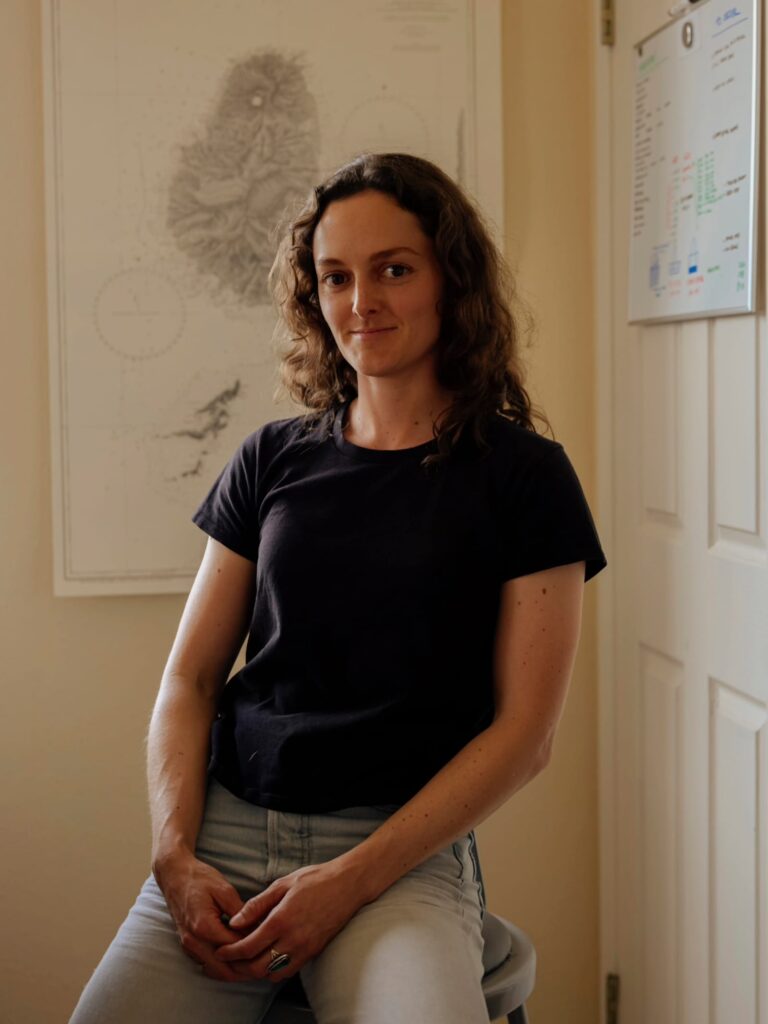
When I asked Emma what was going through her mind when she decided to leave the conventional path and go sailing, I might have expected a story about rebellion or a lifelong dream. It’s possible that my own prejudice is for the big stry right out of a Hollywood drama.
Instead, her answer was remarkably honest.
“I think I was more lost and naive than consciously choosing a path.”
Fresh out of college with a liberal arts degree in Spanish and Printmaking, Emma wasn’t sure what she wanted to pursue. “I had no idea what to pursue with my liberal arts degree in Spanish and Printmaking, and thought traveling for a time might help me parse out the next steps.”
Sailing seemed like a practical answer to an uncertain question.
“I was aware that people lived aboard (having done so with my parents cruising throughout Mexico during my 4th grade year) and figured it would be a cheap, interesting way to see the world.”
Then came the Latitude 38 ad.
“I found a captain looking for crew in Latitude 38 magazine, packed a backpack with free-diving gear and books, and hopped aboard.”
That first decision quickly turned into what Emma describes as a “bit of a misadventure.” She jumped ship in San Diego, met other cruisers who took her aboard, and eventually called four different boats home between California and New Zealand. In New Zealand, she met her partner and continued westward with him for another four years aboard his 1980 Amel Sharki ketch.
What began as a temporary escape from the question of what next? became seven years of living aboard and sailing across the Pacific, Southeast Asia, the Indian Ocean and Atlantic.
When sailing became a lifestyle
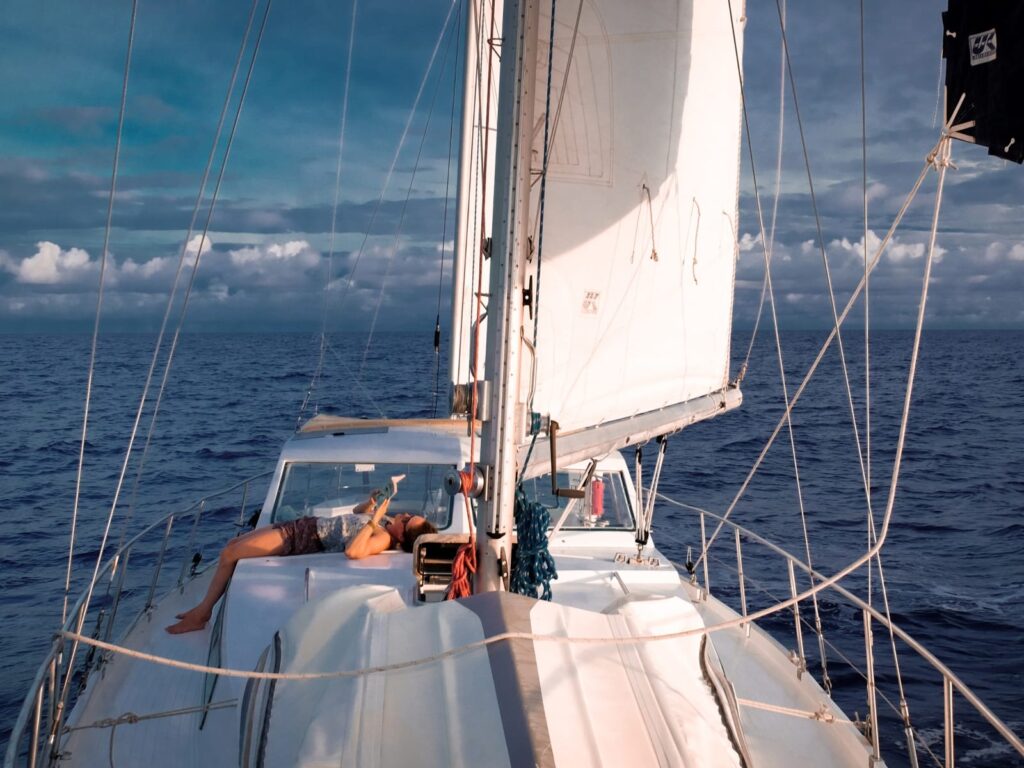
One passage that seems to have crystallized that transformation was a 48-day trip to the Marquesas aboard Ness, a 30-foot steel gaff-rigged ketch. Her captain, Philip, was 68, bearded, denture-clad and a Vietnam veteran. By Emma’s description, he was in many ways her opposite. The boat itself was about as far from modern sailing convenience as you could get.
“We had no electricity, no winches, no head.”
And yet Emma found herself completely captivated.
“But I was enthralled with the pared-down whimsy of it all; paper charts, block and tackle, bucket and chuck it.”
Philip baked challah bread and told stories from an even more rudimentary 15-year circumnavigation in the 1970s. For Emma, something happened during those seven weeks that is difficult to explain to someone who hasn’t experienced a long passage.
The world became very small.
And somehow, at the same time, enormous.
“Ness was a vessel, Ness was a home, Ness was a suffix; vastness, tenderness, worldliness, timelessness, preparedness.”
Then she describes something I think many sailors will recognize immediately:
“The rest of the world ceased to exist. All I had was time and nowhere to be, no one to be.”
She read. She wrote. She drew. She contemplated.
“It felt like we were at the center of a little snow globe of reality with just sea and sky, no physical reference points for seven weeks. I have never felt so free, nor alive. Utterly at the whim of the elements and utterly disconnected”
Perhaps that best captures why people fall in love with sailing in the first place: That is more than a description of a passage. It describes a way of life.
What the ocean teaches you
Seven years at sea inevitably teach you things that are difficult to learn anywhere else. For Emma, one of the most important lessons was confidence. Not the confidence that comes from knowing exactly what you’re doing, but the deeper confidence that comes from knowing you can figure things out when you don’t.
“Something I think I only learned in retrospect was the confidence to trust my own capability.”
She learned that adversity doesn’t necessarily mean you’re in the wrong place. Sometimes it simply means you have to rise to the occasion.
“Repeatedly dealing with adversity in a very visceral, at times life-threatening, capacity forced a deep trust in my own ability to figure things out as they unfold, to rise to the occasion.”
She learned that nothing is permanent. She learned to slow down. She learned to notice small things. She learned to be at peace with very little. But sailing also taught her something unexpected.
She needed people.
“But I was not at peace in my human connections. It taught me that we really are social creatures who thrive on relating.”
Boat life could be transient and lonely, and eventually she came to a realization that changed how she thought about adventure itself:
“As much as I cherish all of my wild adventures in far-flung places, I began to feel that who I’m with matters much more than where I am.”
That may be one of the most important lessons sailing can teach us. The destination matters. The experience matters. But the people beside you matter more.
“Connections are the real meat of this life, and nothing trumps deep personal relationships.”
Coming home can be harder than leaving
After seven years at sea, Emma returned to land. And land was not immediately the answer she expected it to be. She describes it as an identity crisis.
“I had spent all of my adult life identifying as Emma, the friend, daughter, niece who was sailing around the world. Who was I if I was no longer living that lifestyle? Was I still an interesting person?”
Those are difficult questions after any major life transition. But they become particularly profound when the life you’ve left behind has been as defining as sailing around the world. Emma looked at the rush of life on land and wondered what everyone was chasing. She wondered if she was behind.
“And what the hell was everyone doing rushing around and striving for very narrow parameters of success? To what end? In some ways I convinced myself I was behind; that I was only just then learning relational lessons that my peers went through in their twenties while I bobbed around the ocean.”
And then comes one of my favorite lines in the entire interview:
“I communed more with clown fish and retirees than anyone of my generation for almost a decade.”
She acknowledges that maybe she really had been living under a rock.
“But I could probably tell you what type of rock it was and use it to jury-rig a solution to a problem you have.”
That is Emma in a sentence. The experience may not have looked conventional. But it had given her something. She had learned how to make do. How to solve problems. How to live with uncertainty. How to be alone. And how to keep going.
“I guess out there I was jury-rigging community. Loneliness feels a lot easier when you are in the middle of nowhere.”
Coming home meant confronting the loneliness without the ocean to explain it.
“I naively assumed that as soon as I became a landlubber and halted the transience, I would have the community of my dreams. But it has taken years. It has taken four years to grieve the loss of that lifestyle, to build community, to build this business, to feel content and not keep one foot out the door.”
That last phrase says a lot. Not keeping one foot out the door. Learning to stay.
From a ditty bag to Landfall
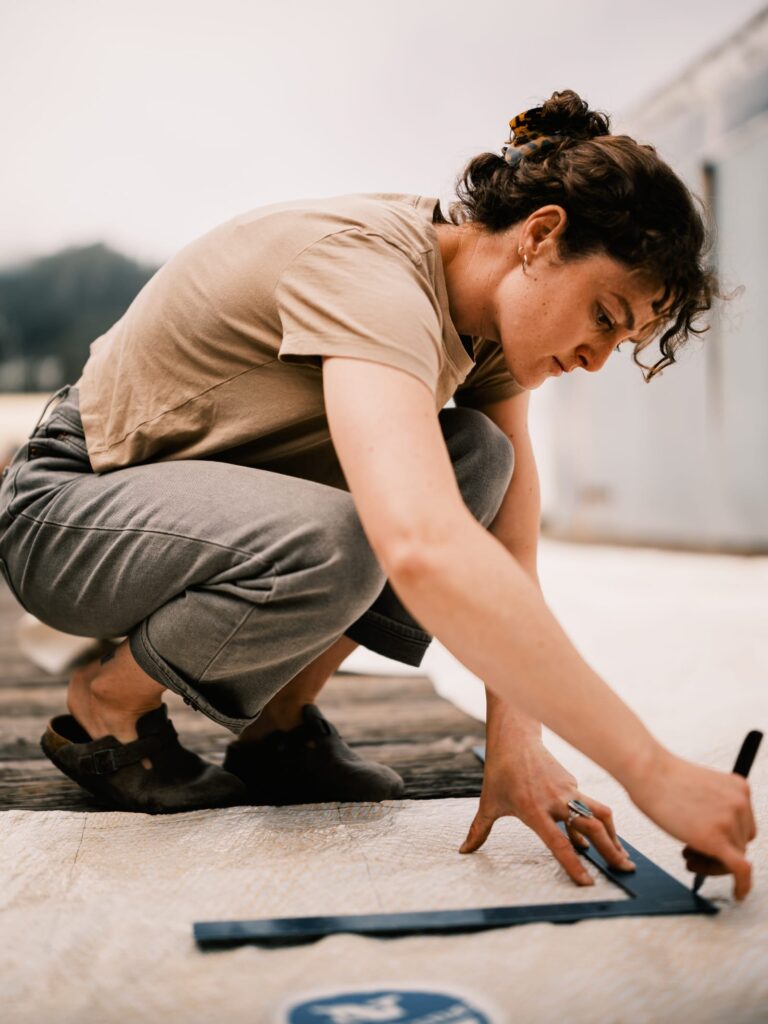
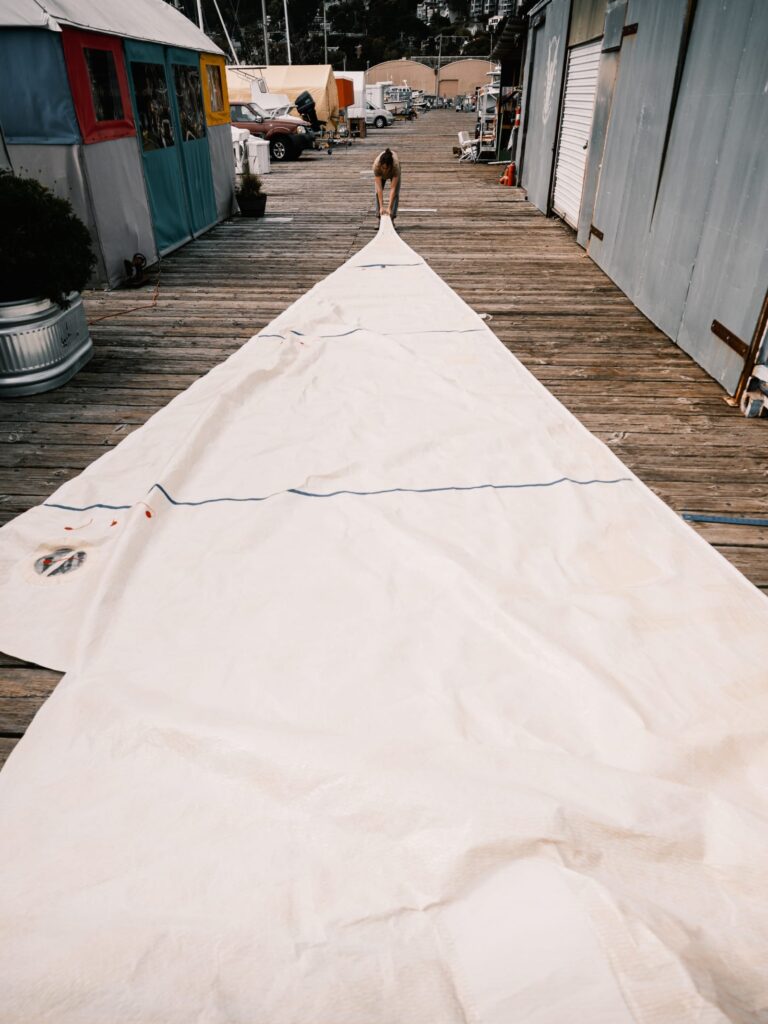
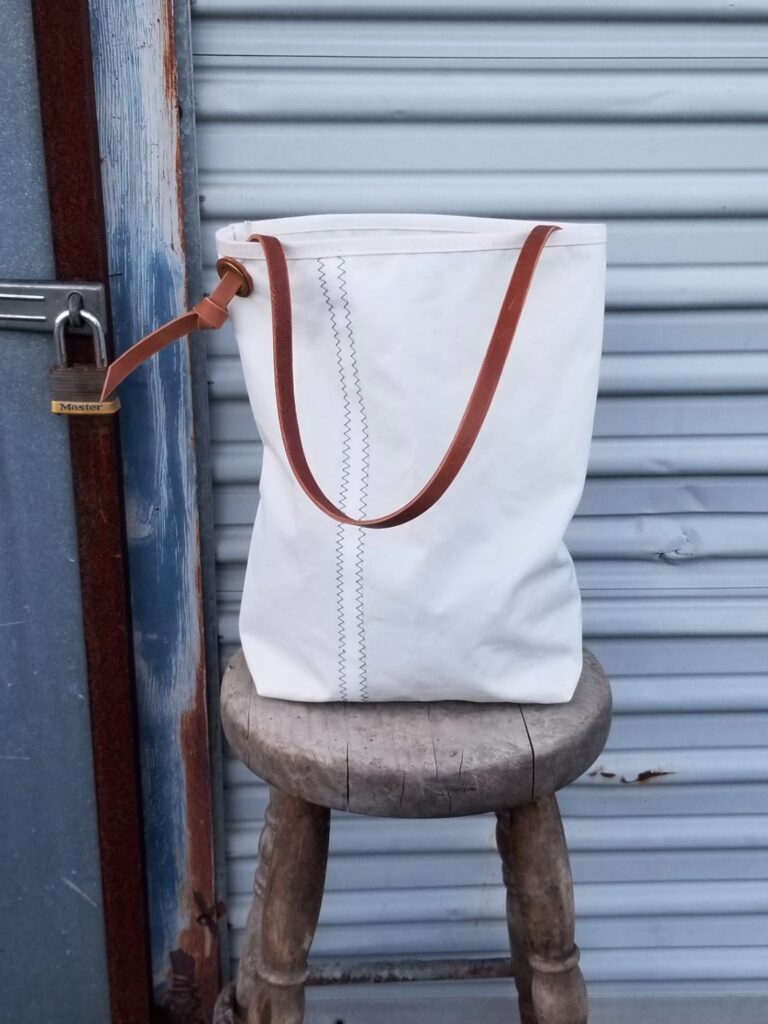
The seeds of Emma’s next chapter were actually planted at sea. On her first long ocean passage, she hand-stitched an old piece of tanbark sailcloth into a ditty bag using marlinspike techniques. She already knew that sails were discarded but after settling back in Sausalito, she began to understand the magnitude of that waste and she started to see possibility.
A sail that had already spent years doing its job didn’t necessarily have to become trash but it could become something else.
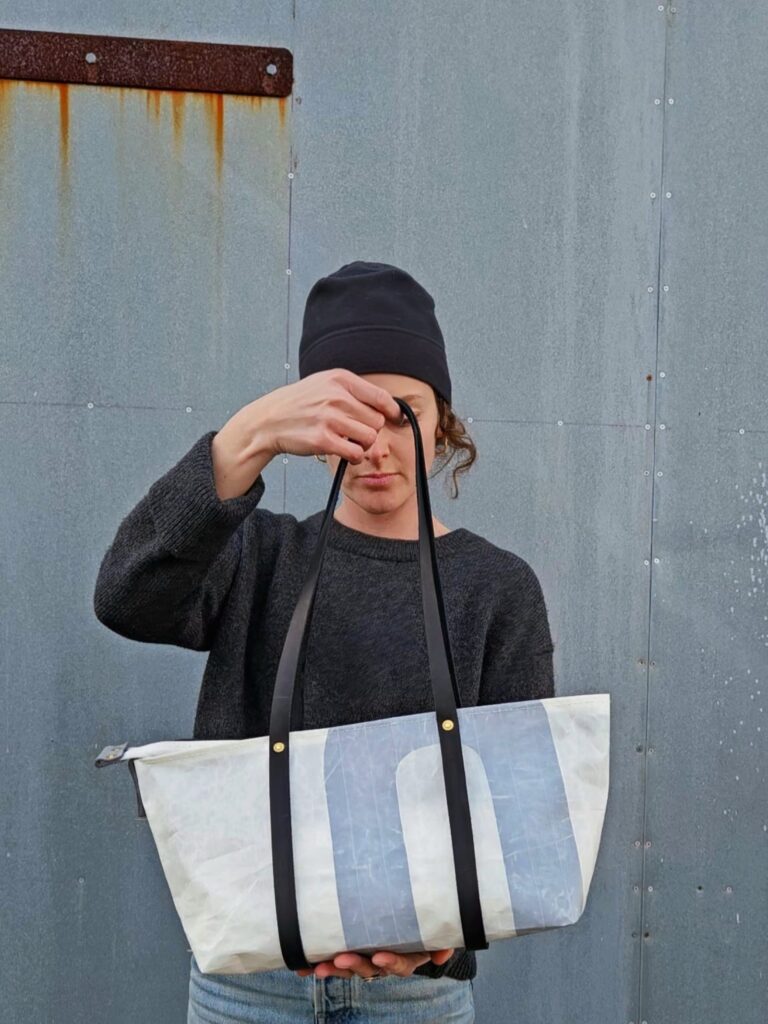
That idea eventually became Landfall.
But what I find particularly interesting is that Emma’s motivation isn’t primarily nostalgia it is practicality.
“Most of my drive to upcycle is purely rooted in the fact that we have already produced far too much stuff.”
She is drawn to the idea of a second use. A circular economy. Existing things being repurposed and given new life. But then she acknowledges the unavoidable romance of the material.
“But I can’t ignore the fact that they literally carried me around the globe.”
One sail in particular carries a powerful memory.
“I’ll never forget retiring our jib after shredding it in a hell of a squall on our approach to the Philippines, and limping the rest of the way to Batangas.”
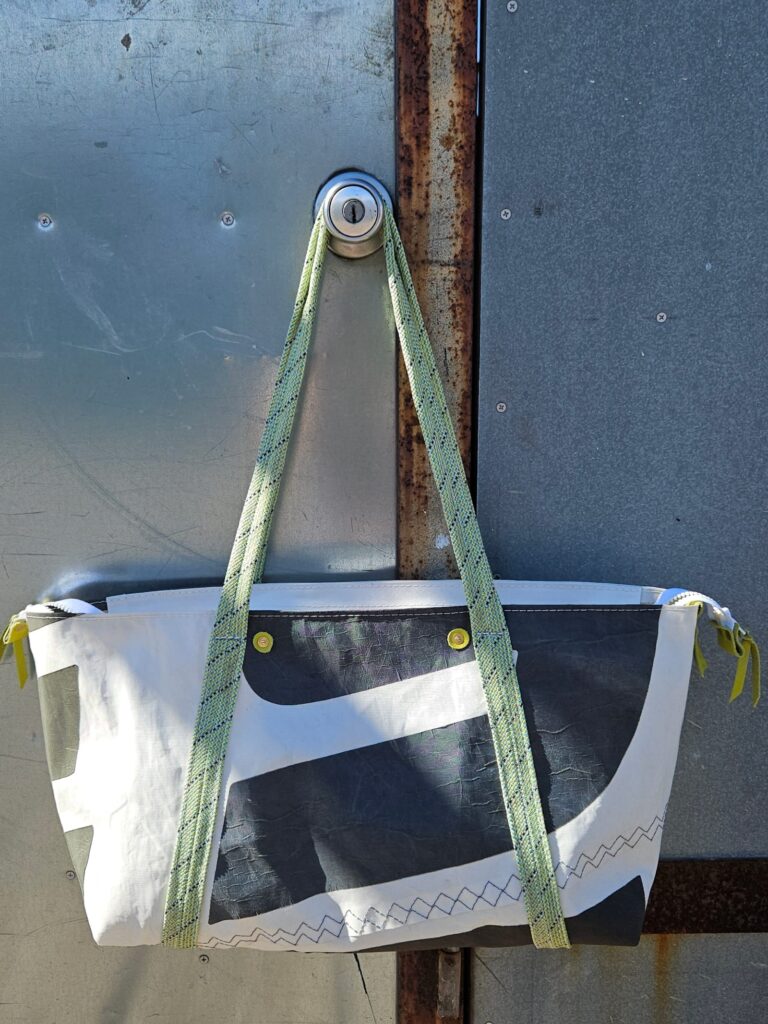
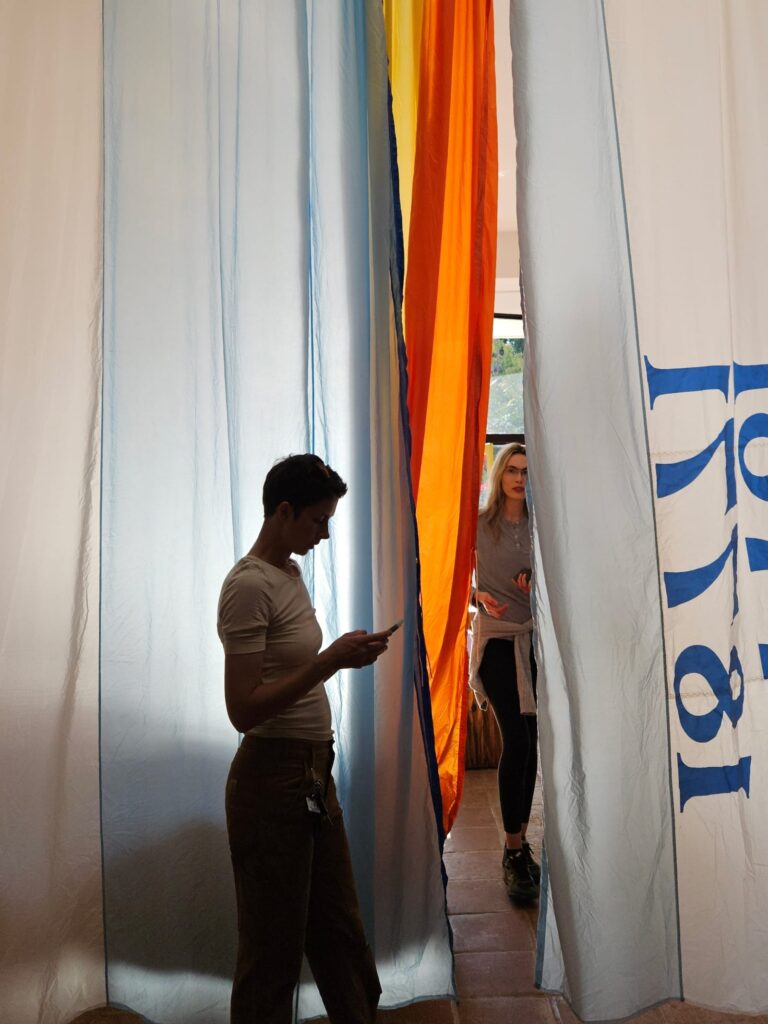
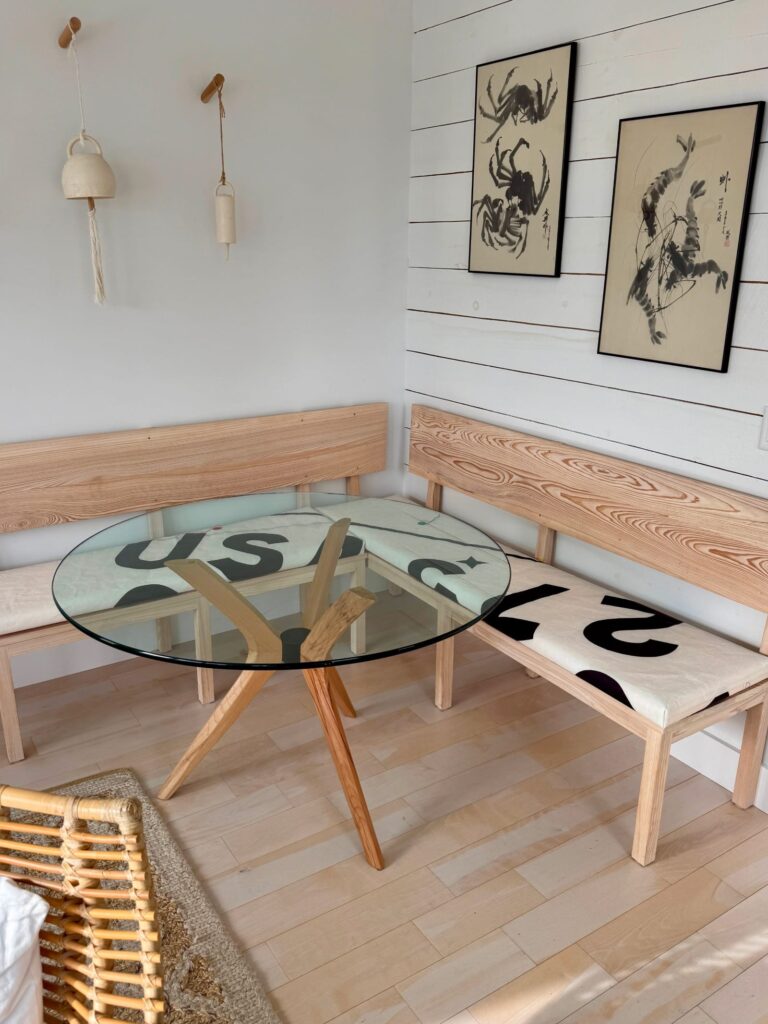
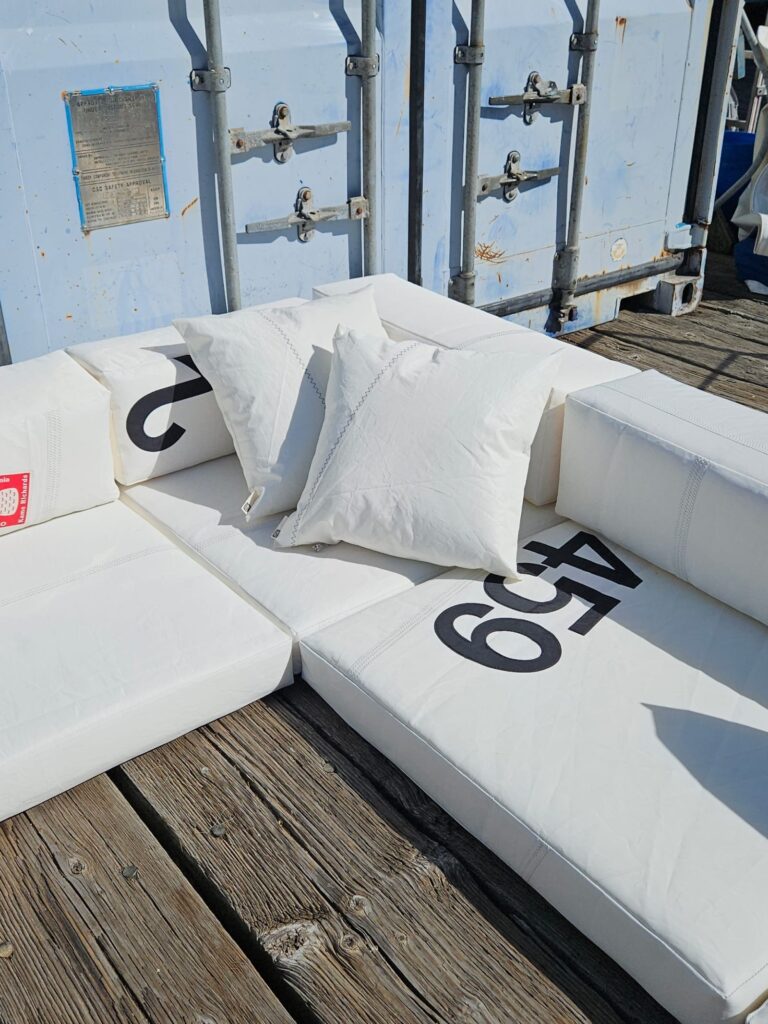
That history doesn’t disappear when the sail is retired. It remains in the material. In the stitching. In the scars.In the reinforced sections. In the reef points. In the numbers and insignias.
“The fabric is also visually interesting. The reinforced areas, zigzag stitching, reef points, numbering and insignias are far more intriguing than rolling out a bolt of new fabric.”
And working with those materials forces Emma to slow down again.
“It makes me think, it makes me slow down and take time to strategize where to cut which pieces and to highlight specific features.”
There is something beautifully circular about that. The same slowness that sailing gave her the time to observe, think, draw and notice is now part of the process of creating each Landfall piece.
Every sail has a past
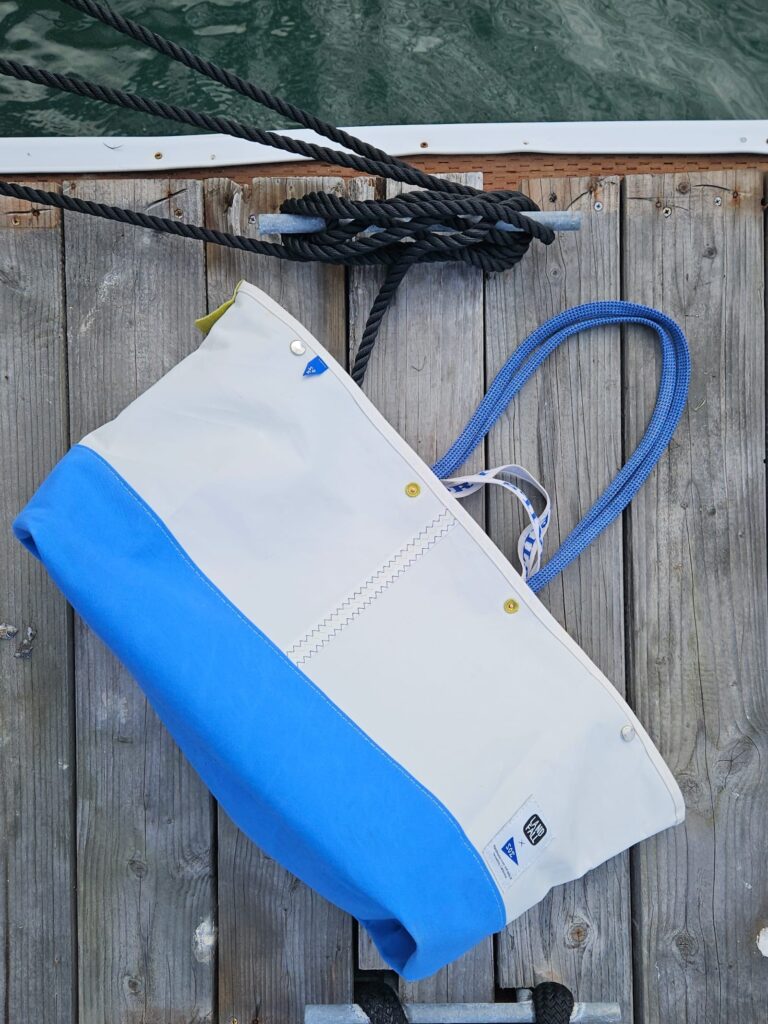
Emma keeps track of what type of boat the sails came from, and that information becomes part of each bag’s story. I asked her whether she ever knows the full history of a particular sail. Her answer was perhaps less romantic than I expected:
“I do keep track of what type of boat the sails come off of, and that information gets added to every bag’s tag. But, I must admit, so far I haven’t heard of any having ventured very far beyond the SF Bay Area or California coast.”
She isn’t disappointed. She is simply more interested in one kind of sailing than another.
“As a cruiser, I’m more intrigued by far-flung voyages than hard core racing.”
Maybe that is fitting because Emma’s own sailing story was never really about racing toward a finish line, it was about wandering, discovering, learning and eventually finding a way to bring those experiences home.
Sailing taught her how to run a business

It is easy to look at a small business and see the product.
A bag made from an old sail. A piece of fabric that has been given another life.
But underneath it is a person navigating an entirely different kind of ocean. Emma describes herself as a one-woman, small-batch business owner, and she doesn’t miss the parallels between cruising and entrepreneurship.
“I’ve been contemplating the ways in which boat life inadvertently prepared me for running a business. Life aboard gave me grit and perseverance, the ability to endure discomfort and truly acknowledge that this too shall pass. It gave me skills to problem solve with limited resources – we couldn’t Google things or walk to the hardware store.”
But then she identifies something even more important.
Time.
“But most of all it gave me time.”
Time to be present. Time to pay attention. Time to notice the weather and sea creatures. Time to write about a customs official in Rabaul Harbor, Papua New Guinea. Time to painstakingly illustrate rock formations in Hanavave Bay in the Marquesas.
“My creativity was really fostered in that slowness.”
And then comes the connection between the sailor she became and the entrepreneur she is today:
“Those seven years at sea are what really built this business.”
But, as every sailor eventually learns, no passage is ever truly single-handed.
“But right now I’m learning that single-handing is hard. It might be time to take on crew.”
“Sailing isn’t rocket science”
One of the things I appreciated most about talking with Emma was how little mythology she puts around what she accomplished. Seven years living aboard while crossing oceans and traveling through some of the most remote places on earth and building a business from the experience.
It would be easy to turn that into a heroic story about an extraordinary person doing something most people could never do.
Emma doesn’t see it that way especially when it comes to women considering sailing.
“Sailing isn’t rocket science. And neither is running a business.”
During her cruising years, people frequently told her:
I wish I could do what you’re doing.
Her response is simple.
“And the truth is, you can.”
Of course, she doesn’t pretend it’s easy.
“I think most people are simply unwilling to leave their comfort zone, to take risks.”
There is the discomfort.
And there are moments when everything goes sideways.
“It isn’t easy, and it is often very uncomfortable contending with oppressive tropical heat, seemingly interminable squalls, sleeplessness, limited access to resources, and occasional shit-hits-the-fan moments of sheer terror.”
“But it takes you to phenomenal places, and exposes you to life-altering experiences.”
And she sees the same thing in entrepreneurship.
“I suppose the exact same can be said about starting a business.”
Take the plunge
This is where Emma’s story comes back to that 21-year-old who found an ad in Latitude 38 and decided, perhaps somewhat naively, to step aboard a boat. She didn’t know where it would take her. She didn’t know she would spend seven years sailing around the world, that she would struggle with coming home, or that the things she learned at sea would eventually become the foundation of a business.
She just took the next step.
So I asked her what she would say to someone today who is dreaming about sailing but hasn’t found the courage to go. Her answer was exactly what I hoped it would be:
“Take the plunge.”
Then she put it even more simply:
“Life is short and needs to be grabbed ahold of.”
There will be misadventures. There will be uncertainty. There will be moments when you wonder why you ever decided to leave the dock. But those moments may become the stories you tell for the rest of your life. “The mild misadventures become the best stories.” And then, with a line that perfectly captures the spirit behind her entire journey:
“You’ll never look back and think ‘wow, wasn’t that a phenomenal month I spent at the office!’”
Everyone has a way in
That is what I came away with after talking to Emma.
There isn’t one way into sailing. There isn’t one kind of sailor. There isn’t one definition of what a sailing life is supposed to look like. For some, it is a racecourse. For others, it is a family boat on a summer afternoon. For someone else, it is a charter in the Caribbean, a weekend aboard a friend’s boat or a first lesson that opens up an entirely new world.
And for Emma, it was an uncertain 21-year-old stepping aboard a 35-foot cutter in Half Moon Bay with a backpack, some books and no real idea what would happen next.
That is the beauty of sailing.
You don’t always know what you’re stepping into.
But the experience has a way of changing you.
Sometimes the biggest impact doesn’t come from the destination. It comes from the way you learn to see the world along the way.
Today, every piece of sailcloth that passes through her hands has another chance at a life.
Emma spent seven years learning that lesson at sea.
Then she brought it home.
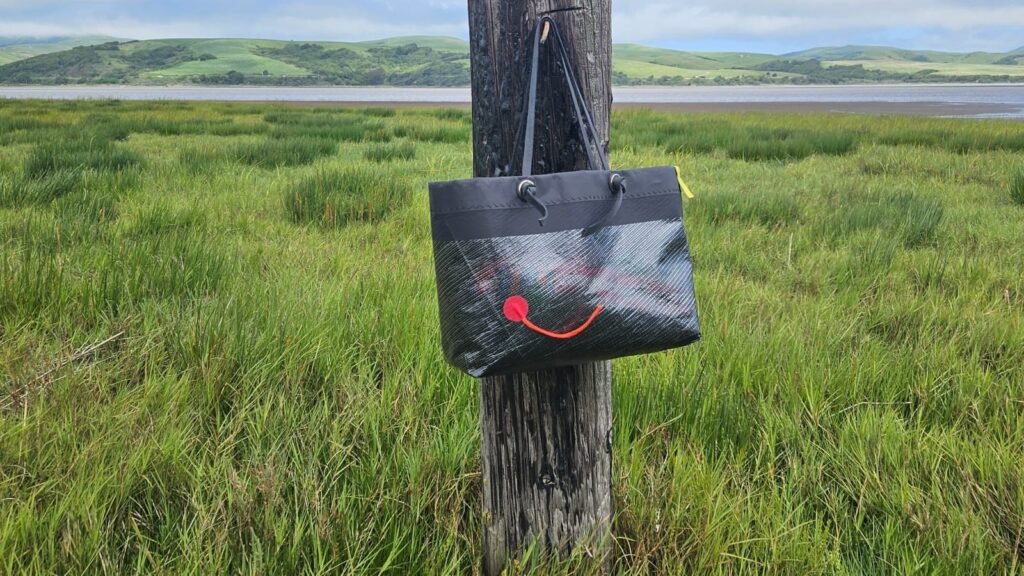
And perhaps that is the larger story behind Landfall.
Not simply that an old sail can become something new.
But that what we experience our adventures, our mistakes, our scars, our skills, and even the parts of our lives we think we’ve left behind can keep shaping what comes next.
We just have to be willing to take the plunge.
About the Author
Zeke Quezada is the Director of Communications for American Sailing and Director of American Sailing Vacations, leading brand strategy, digital education, and experiential growth initiatives. He developed scalable online sailing education tools and helped expand American Sailing Vacations into a global provider of Learn to Sail experiences, flotillas, and sailing adventures that connect education, travel, and community.

Join The Discussion