

The Sailors’ Sidekick

The Sailor’s Sidekick

Rigging Knives
The Sailor's Sidekick

AD: SUNSAIL
ADVERTISMENT

AD: PREDICTWIND
ADVERTISMENT

AD: GARMIN
ADVERTISMENT

AD: SAILTIME
ADVERTISMENT

By Simon Horwith

Rigging Knives – The Sailors’ Sidekick

One of the things that has always attracted me to sailing is the connection that it makes me feel to thousands of years of nautical history. The fundamentals of sailing are the same now as they were when humans first took to the water, although scientific and technical advances have evolved sailing equipment over the centuries. While the technologist in me appreciates and welcomes these innovations, the Old Salt in me is drawn to the tools and techniques of days gone that have remained largely unchanged and are still just as relevant today. 

Ever since we took to the sea on wind-powered craft, rope has played a critical role, and for that reason, so have knives. Even now, a marlinspike knife is one of the four things that I carry every single time that I set sail (the other three things are a PFD, a handheld VHF, and a whistle). 

In this article, we’ll look at what makes a sailing knife different from other knives, why they are such a critical piece of equipment, and for anyone looking to purchase a rigging knife, I’ll offer some advice and recommendations.

Designed for Safety and Utility

Rigging knives combine blade, spike, and shackle key into one reliable piece of safety gear.

There are many types of knives in the world, and simply carrying a knife while you’re underway does not make it a sailing knife. Rigging knives have certain characteristics that make them better suited for use on boats, and they are usually bundled or equipped with additional tools to meet the specific needs of sailors. 

Before we continue, I will mention that rigging knives are available as folding knives or fixed blade knives. I prefer folding knives because they are less bulky and can be carried in a pocket, and because when folded, they are safer to pass to other crew members. In this article, we’ll focus on the folders, but if you work with huge lines (3”+) and/or need serious chopping capabilities, then you may want to invest in a fixed blade.

You may have noticed that I used the terms “sailing knife,” “rigging knife,” and “marlinspike knife” without explanation. They are all valid terms to describe a knife that’s designed for use at sea, and I’ll use the terms interchangeably in this article.

So what qualifies a knife as being “designed for use at sea?” There are three primary components that make a knife ship-shape: the blade, a shackle key, and a marlinspike.

Blade

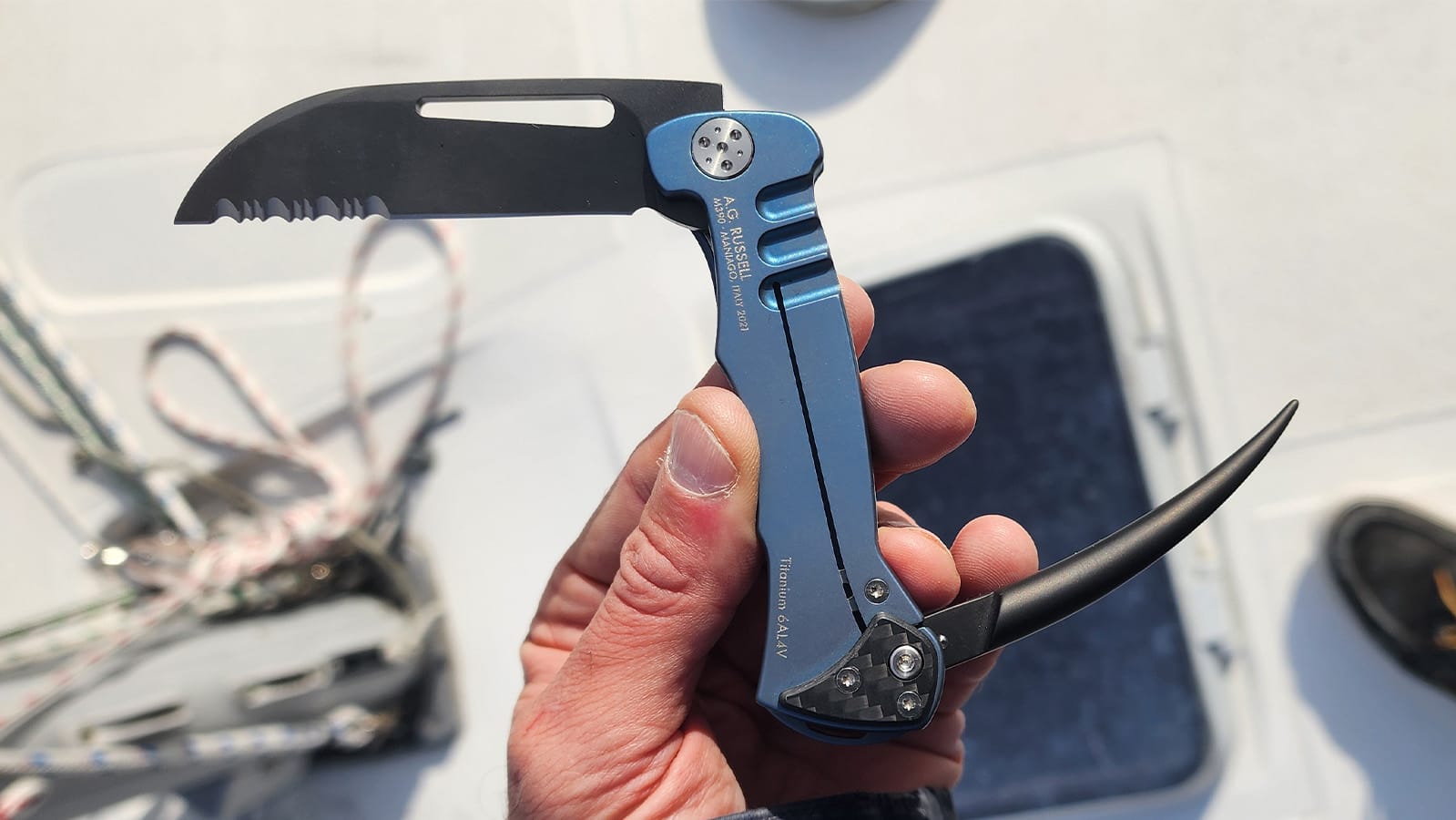
Serrated edges excel at slicing through loaded or worn rope when every second matters.

The primary function of a rigging knife, as with any other knife, is to cut things. This is an essential utility for general maintenance tasks and is also a very important part of boating safety. In an emergency, lines or straps that need to run free but can’t, may pose a significant threat, either as the cause of an emergency, or as the thing preventing you from quickly resolving an emergency. Two examples of scenarios where a knife blade can save lives include cutting a lifejacket strap or a line that is entangled on something and is preventing a person from being able to escape/swim/move freely, and in a crew overboard situation when a line is preventing you from being able to throw a line or flotation device to the person in the water.

Due to harsh conditions at sea, namely exposure to salt water, a good rigging knife blade will be made of a material that resists rust and corrosion. Some blades are made of titanium/titanium alloy or ceramic, but stainless steel (400 series) is the most common material. For edge retention and sharpening reasons, I personally recommend going with stainless steel blades. Rigging blades can be serrated or straight (or both). In my experience, a straight blade works very well if you put in the effort to keep it razor sharp, but serrated blades can go through tougher material easier and keep their sharpness longer before requiring sharpening.

A corrosion resistant sheepsfoot blade designed to cut lines quickly without the risk of accidental punctures.

The traditional shape of a rigging knife blade is known as a “sheepsfoot.” It has a single, straight (not curved), sharp edge and a spine that runs parallel nearly the entire blade length and abruptly drops to meet the edge at the end. This results in a very flat (not pointy) tip, which is important because on a moving boat, especially in rough seas, there is an increased chance of accidentally puncturing yourself or others, not to mention an inflatable. 

Marlinspike

Using a marlinspike to pry apart knots that cannot be loosened by hand alone.

A marlinspike is a slightly curved spike that tapers from one end down to a tip. They can be useful if you need to punch a hole in the lid of a can or in a sail, but the primary purpose of a marlinspike is to splice lines and break (open) knots – especially those that have seized or bitten down to the point that they can’t be untied by hand.

To break or loosen a knot with a marlinspike, you work the spike point into the knot, between the loop or bight that you want to make loose from the rest of the knot, pushing the spike until it passes completely through the knot. The marlinspike taper will naturally create and open a gap in the knot… and knots that are particularly difficult may also require that you use the curve for leverage and work the spike in various directions while it has penetrated the knot, to pry it open.

Because the spike needs to bore its way through the knot but you also do not want to damage the line, the tip can be rounded or fairly sharp, but should not be so fine that it will cause damage to any line being worked on. Rounded marlinspikes have a greater circumference, so they generally have a sharper tip, whereas marlinspikes that have a more oval circumference might have a more blunt tip because their “flatter” shape is naturally more easy to work between two lines.

Shackle Key

A shackle key provides added leverage when shackles are frozen or impossible to turn by hand.

A shackle key is a fairly flat piece of metal that has a tapered slot cut into it, which you use to open shackles that cannot be opened by hand. The key increases the amount of torque that you are able to apply when attempting to turn a shackle pin, and the slot is tapered so that it can accommodate a wider variety of shackle pin head sizes and shapes. 

Using a shackle key to open a shackle is as simple as slipping the key slot over the pin head so that the head is “trapped” inside of it, then turning the key so that the shackle pin also turns along with it. Some rigging blades or marlinspikes double as the shackle key, which is cut out of the spike or out of the blade near the thicker rigid spine of the blade, and others include the shackle key as a separate tool.

Selecting a Rigging Knife

As long as a knife is sharp and will withstand the abuse that it will undoubtedly take at sea, the right rigging knife for you is a matter of personal preference. I generally only carry rigging knives that have a shackle key and marlinspike, but there are knives available (like the Spyderco Salt series knives) that aside from not having the other tools, are still fantastic blades. I often keep knives like that below deck as a backup.

The feel of a knife’s weight, balance, and handle are also important. I recommend test-holding a knife before you buy it if possible, and if you wear gloves when you sail, then think about how the knife will feel when you’re trying to open and use it with gloves on.

The blade on a marlinspike knife doesn’t technically have to lock in place since it’s single edged and without a point, although some people prefer a blade that locks. It’s critical however, that the marlinspike and the shackle key lock in place because you will most likely be putting a lot of stress on them, and would be dangerous if they aren’t locked in place. Please note that a shackle key that’s cut into a folding blade that does not lock is not a safety issue as long as you use the shackle key only when the blade is closed.

It’s also important to consider how you will carry the knife before you buy one. There are many options. Some knives come with a belt loop or carabiner sheath, or a pocket clip, or a lanyard hole… I think they’re all perfectly fine, but I strongly advise having some way to attach the knife to your body when carrying and/or using it, other than keeping it loose in your pocket, lest it become a gift to Neptune.

Once you know what features you’re looking for in a rigging knife, the rest is a matter of personal preference and budget. I don’t recommend purchasing any sailing knife that is very low priced (under $40) or isn’t made by a reputable knife maker, but that also doesn’t mean that you have to spend a small fortune. I’ve owned dozens of sailing knives and I’m always on the lookout for the perfect knife at the perfect price.

Rigging knives combine blade, spike, and shackle key into one reliable piece of safety gear.

In my experience, most of the reliable, well-made marlinspike knives are in the $90 – $150 range. Of all the companies selling knives in this range, a good place to start is with Myerchin knives: they have several excellent rigging knife models and styles that are all available in this price range.

If you really love knives and money is no object, the “Folding Boating and Rescue Sheepsfoot with Titanium Marlinspike” from Boye Knives is a serious high end workhorse (cost is around $240) and coming in at $350 is the A.G. Russell “Seamaster 2.0,” which is exceptionally well made and dead-sexy.

I said earlier that I don’t recommend lower cost sailing knives because none have proven to be reliable in real use or of decent quality in general… but my new personal favorite marlinspike knife to carry is a $60 bargain that was quietly released at the end of 2024, which I discovered at this year’s Annapolis Sailboat Show: the Tekna “Sailor’s Edge”. If the name “Tekna” sounds familiar, they have been making some of the best dive knives for decades, but this is their first rigging knife. The lanyard hole on it could be a little bit larger, but otherwise, it’s a great marlinspike knife at a very reasonable price.

Conclusion

Marlinspike knives are an often-overlooked and underappreciated piece of sailing gear, but having a tool on-hand to slash and free lines in an emergency or to unfreeze a shackle or break open a stubborn knot, is a valuable time saver and can even be a life saver. It doesn’t have to cost much to get one, and it isn’t any effort to carry with you at all times. I still remember the cheers and free beers that I earned when, while on a mooring two summers ago, where I jumped overboard with knife in hand and freed the fouled prop of a neighboring boat. When everyone else onboard your vessel or at the dock is trying to unstick some pesky piece of hardware, being the prepared captain always earns the respect, thanks, and accolades of your fellow sailors.

About the Author

Simon Horwith has been sailing for more than 50 years, starting before they could walk as part of a sailing family on Long Island Sound. Most of that time has been spent cruising, with deep experience developed both on the water and through instruction.

They are a USCG Licensed Captain (25-ton Master with sailing endorsement), a USCG Auxiliarist, and an ASA Instructor. Much of their sailing takes place in New York City’s busy waterways, where heavy traffic, tight quarters, and constant decision-making sharpen real-world skills. In addition to teaching, they also help maintain the school’s fleet.

Because many instructors sail primarily within the school and club environment, students with more advanced or technical questions are often referred to them. Among fellow instructors, they’re known as “the knot guy,” thanks to a long-standing fascination with knots and a deep understanding of how and why they work.


Join The Discussion

Sorry, there were no replies found.

Log in to reply.


AD: SAILTIME
ADVERTISMENT

AD: PREDICTWIND
ADVERTISMENT

AD: SUNSAIL
ADVERTISMENT

AD: GARMIN
ADVERTISMENT