




In the official language of the USCG, a wearable device that will keep you afloat should you fall in the water is a “personal flotation device” or “PFD.”
Lifejacket and PFD are interchangeable terms.
PFDs are officially classed as Types I, II, III, IV, and V, according to their design, construction, and intended use. The specific type required aboard depends on the type of vessel, its use, and the waters in which it sails.
Life jackets save lives. A vessel underway must carry a USCG-approved life jacket for every person aboard. The jackets must be readily available for use and the correct size for the individual user. A life jacket is designed to save your life, but it can’t do that if you’re not wearing it.
Who should wear a PFD?
Safety regulations require that boats carry life jackets but mostly leave it up to the individual to choose whether to wear one or not. Always honor your skipper’s (or instructor’s) directives regarding the use of life jackets and other personal flotation devices (PFDs) such as inflatable belts.
Most state laws require that children under a certain age wear a life jacket when afloat. and it is just plain common sense that life jackets should always be worn on dinghies (which can capsize) and on keelboats without lifelines.
The skipper should encourage everyone aboard to wear a life jacket and, when necessary, require crewmembers to wear them. his decisions may be based on such factors as age, experience, or physical condition, whether the individual has to leave the cockpit to work on deck, the type of boat, and the weather conditions. Many skippers require every crew to wear a life jacket at all times on deck. When it comes to safety, more is always better.
When Should You Wear a PFD / LifeJacket?
- If you can’t swim
- In bad weather or big seas (it’s OK to set a low threshold)
- When the water temperature is cool
- When the clothing you are wearing would make swimming difficult
- If you are tired or not feeling well
- When sailing with an inexperienced crew or young children
- When sailing singlehanded or with just a few other people aboard
- At night or in reduced visibility
- When moving out of the cockpit
- At any time you feel more comfortable wearing one
- At any time when sailing on a boat with no lifelines
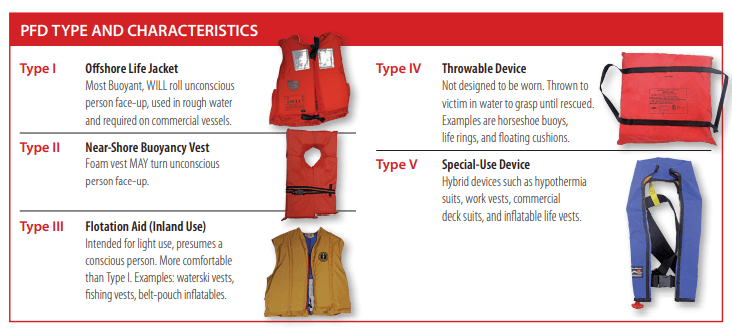
Types of Personal Flotation Devices (PFD)
Type I Offshore life Jacket – Most Buoyant, WILL roll unconscious person face-up, used in rough water and required on commercial vessels.
Type II Near-shore buoyancy vest – Foam vest MAY turn unconscious person face-up.
Type III Flotation aid (inland use) – Intended for light use, presumes a conscious person. More comfortable than Type I. Examples: waterski vests, fishing vests, belt-pouch inflatables.
Type IV Throwable Device – Not designed to be worn. Thrown to victim in water to grasp until rescued. Examples are horseshoe buoys, life rings, and floating cushions.
Type V Special-use Device – Hybrid devices such as hypothermia suits, work vests, commercial deck suits, and inflatable life vests.