




By Jon Lacks
Almost a decade ago, my family and I made our own modern-day Lewis and Clark-style transition — from coastal New England to the high desert of Central Oregon. While Oregon is technically a coastal state, the Cascade mountain range stands firmly between us and the Pacific. The move meant trading tidal harbors and familiar moorings for pine forests, alpine lakes, and long drives to find saltwater.
What didn’t change was our appetite for sailing.
Like many sailors who relocate inland, we faced a familiar question: Does sailing still fit when the ocean is no longer close at hand? The answer, it turned out, was absolutely yes — but only if we were willing to rethink how we accessed the water.
For us, this rethinking led directly to the world of trailer sailing.
A Shift in Perspective
Back on the East Coast, our sailing routine was familiar and well established. We owned monohulls living on moorings about twenty minutes from home during the warmer months. Each fall, a professional service hauled the boats at public ramps, helped along by commercial-grade, hydraulic-powered trailers and generous New England tides. Our boats were tucked away on trusty blue Brownell stands for the winter.
The model worked beautifully, until geography changed.
Moving inland forced us to confront assumptions we hadn’t realized we were carrying: sailing required a home harbor, boats needed to stay put, and access to water dictated whether sailing was practical at all. Trailer sailing challenged each of those ideas. Rather than limiting our options, it offered a way to make sailing portable.
It wasn’t a step backward. It was a widening of the map.
Myth #1: “Trailer Sailing Is Complicated and High Risk”
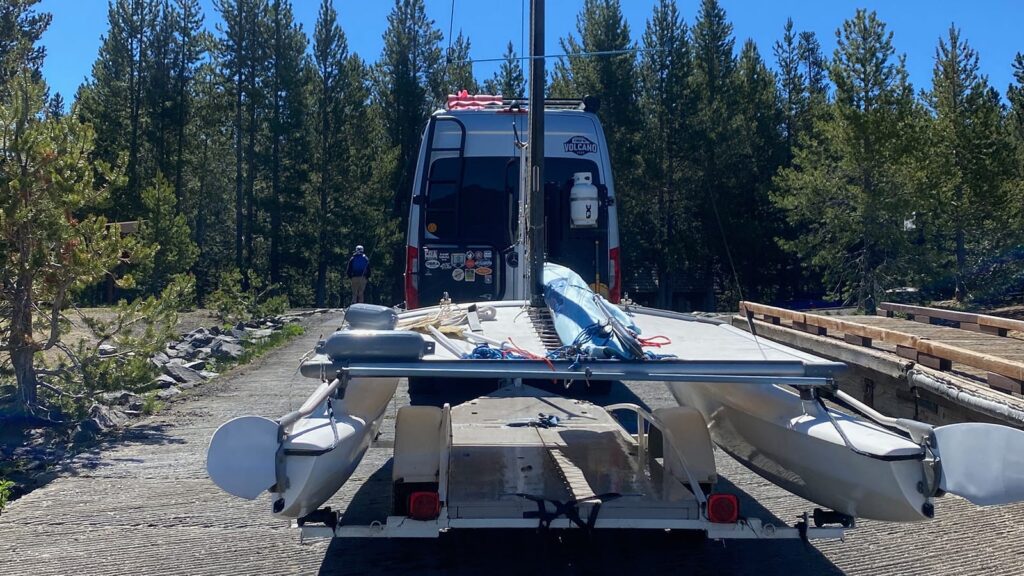
Our introduction to trailer sailing began deliberately small. We found a used Hobie 16 with a single-axle trailer — no brakes, no fancy systems, and light enough to be towed behind a modest vehicle. The goal wasn’t to find a forever trailerable boat; it was to build experience on the road.
Our first tow was a six-hour round trip over mountain passes to bring the boat home to Central Oregon. Preparation was basic but intentional. We performed a careful visual inspection of the trailer, inflated the tires, confirmed the lights worked, secured the mast and hulls, and trusted (perhaps a bit optimistically) the seller’s assurance the trailer “should do fine.”
The drive itself was uneventful, and that was the point. We drove conservatively, took wide turns, and made several safety stops to recheck tie-downs, tire pressure, and bearing temperature using the rudimentary “fingertip check” on the dust caps.
That first trip taught us something important: trailering isn’t inherently dangerous; it simply demands the same mindset as good seamanship. Preparation, margin, and situational awareness go a long way.
Lesson Learned: Trailering Is Seamanship on Land
Over time, we developed a simple pre-tow routine mirroring a pre-departure boat check:
- Trailer structure: Inspect the frame, welds, and tie-down points for corrosion or cracks.
- Tires and wheels: Check tread, sidewalls, and pressure; confirm lug nuts are secure.
- Lights and wiring: Test brake lights, turn signals, and running lights before every trip.
- Coupler and safety chains: Ensure the coupler matches the ball size, locks securely, and chains are properly attached.
- Bearings: While difficult to fully inspect on the road, frequent stops to check for excessive heat at the hubs (using the fingertip method) can catch problems early.
- Paperwork: Trailers often require separate registration; know your state’s requirements.
None of this is exotic or technical. It’s simply attentiveness. The same habits keeping us safe on the water apply equally well on the highway.
Myth #2: “You Must Own a Big Vehicle”
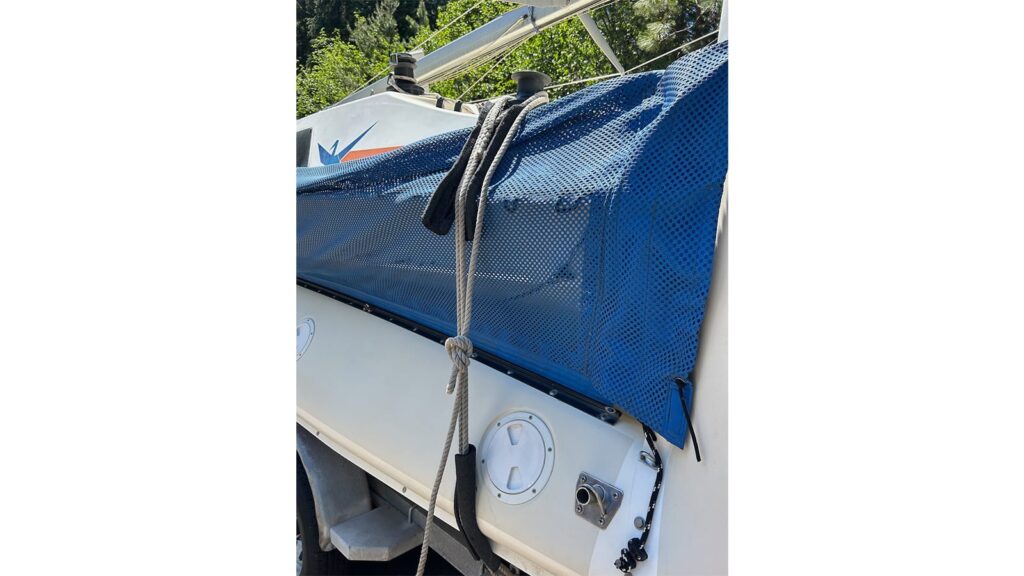
Another persistent misconception is trailer sailing requires a heavy-duty truck and an oversized towing budget. While towing requirements do increase as boats get larger and heavier, many well-designed trailerable sailboats are intended to be towed safely by mid-sized SUVs or light trucks when the entire system is properly matched.
Every tow vehicle has defined limits, clearly outlined in the owner’s manual and manufacturer specifications. Two numbers matter most: the maximum tow rating, indicating the heaviest trailer the vehicle is designed to pull, and the Gross Combined Weight Rating (GCWR), representing the maximum allowable combined weight of the fully loaded vehicle and trailer — including passengers, fuel, gear, and the boat itself. Operating within these limits provides an important safety margin, predictable handling, and adequate braking performance.
Starting with a smaller, lighter boat allowed us to focus on fundamentals rather than capacity limits. We learned how trailers behave under load, how wind and speed influence stability, and how route planning, braking distance, and rest stops factor into longer tows. Those lessons were incremental and transferable, and they built confidence.
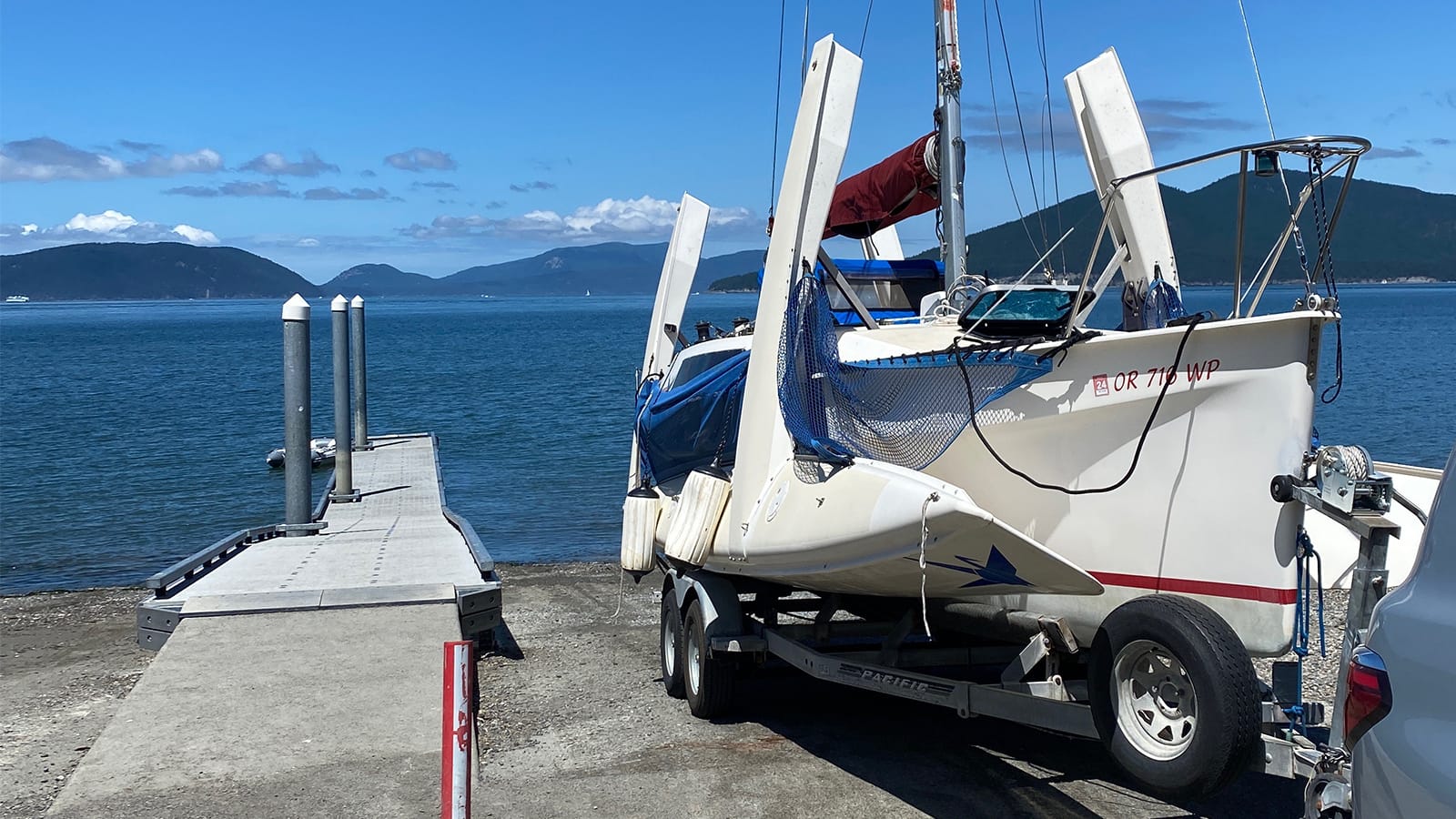
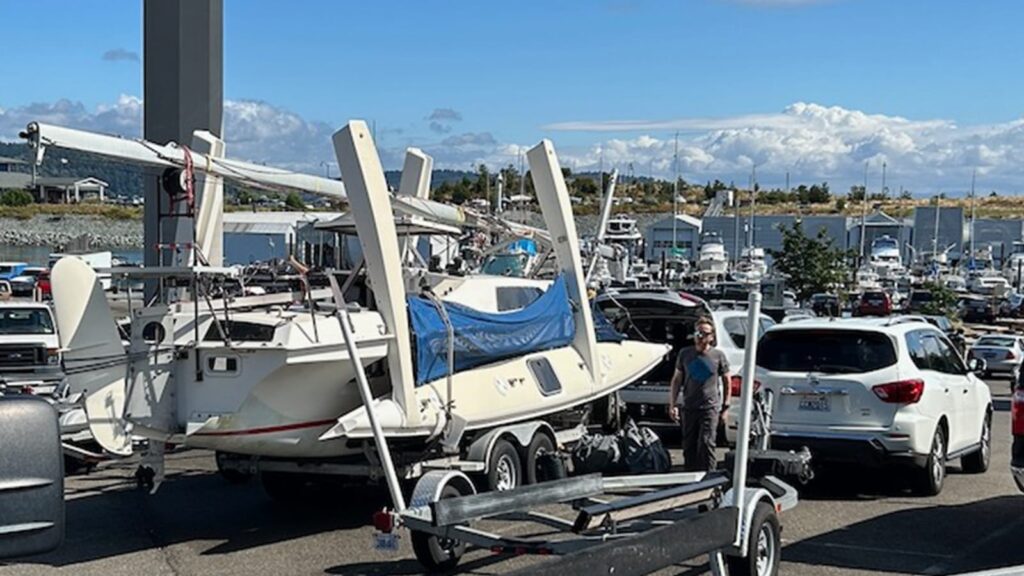
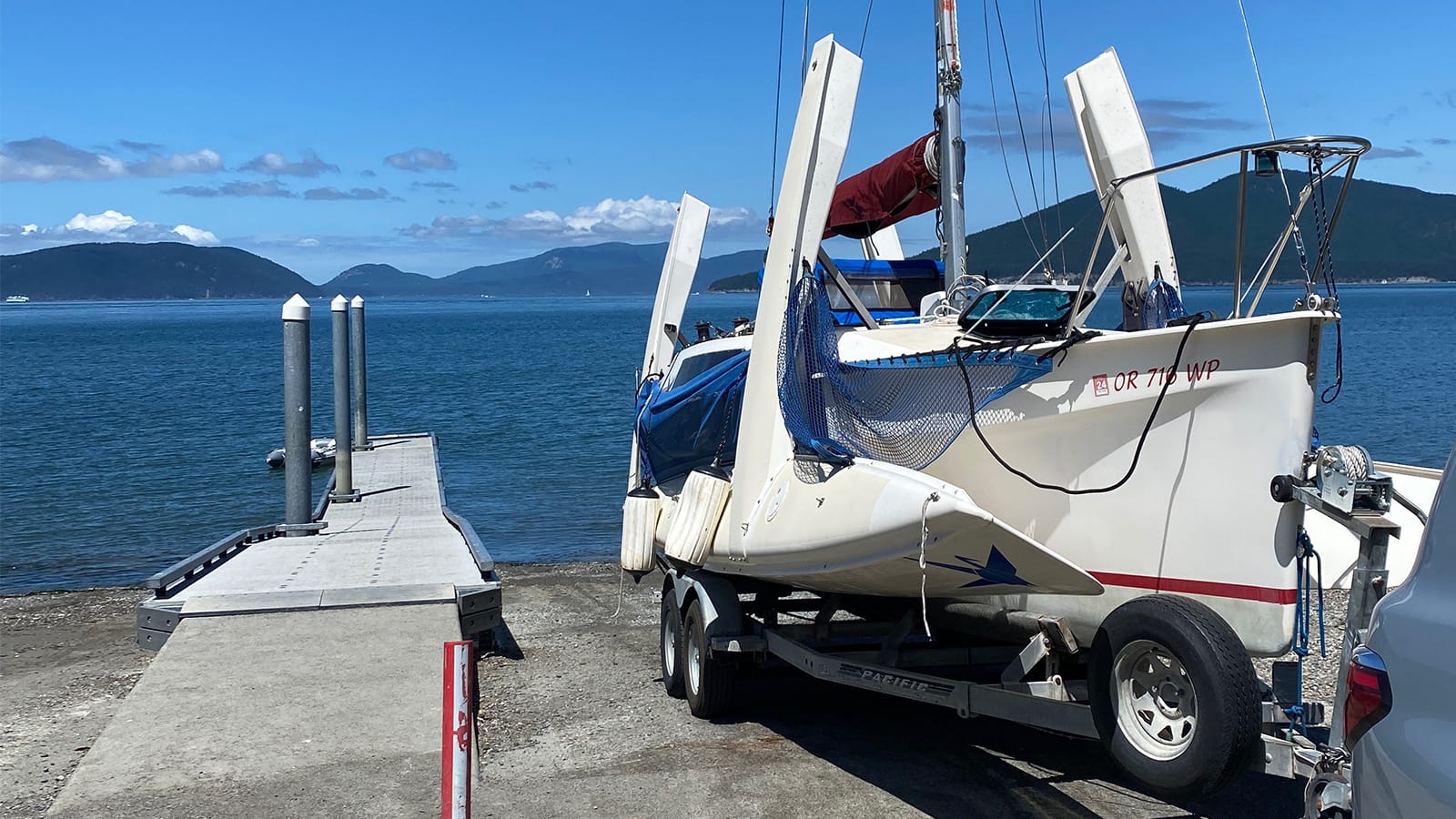
As our experience grew, so did our ambitions. Eventually, those lessons led us to a very different kind of trailer sailor: the Corsair F-27 folding trimaran. Its increased weight, length, windage, and long-distance towing profile required a more capable tow vehicle. The evolution naturally introduced new considerations, from dual axles to surge brakes and more robust suspension, each bringing additional capability along with additional responsibility.
Evolving to a More Complex Trailer System: A Bigger Boat
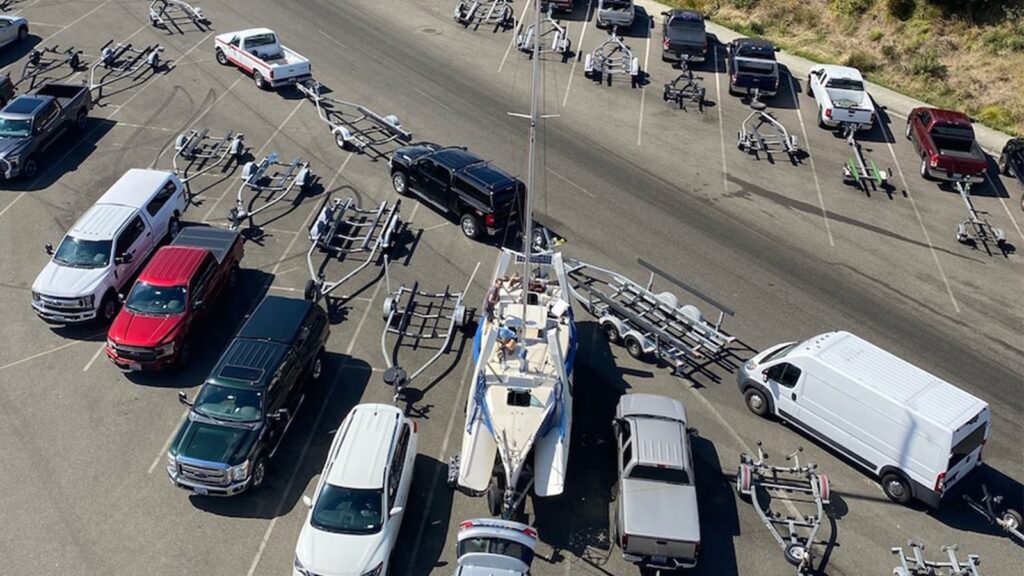
The Corsair F-27 represents a very different trailering experience from the Hobie 16. The boat rides on a dual-axle trailer equipped with surge brakes, carries significantly more weight, and presents a much larger aerodynamic profile. While the fundamentals of trailering remain the same, the margin for error narrows as size, weight, and windage increase.
Long-distance towing with this setup required a reassessment of the entire towing system. We ultimately chose to upgrade to a vehicle better suited for sustained towing: one with higher tow capacity, a longer wheelbase, improved braking performance, and enhanced cooling under load. The difference was immediately noticeable, not only in increased safety margin, but also in reduced driver fatigue and smoother, more predictable handling on long hauls.
This evolution reinforced an important lesson: upgrading boats often means upgrading the systems around the boat as well. Trailer sailing works best when the boat, trailer, and tow vehicle operate as a single, integrated system, each component supporting the others.
Lessons Learned: Managing More Complex Trailers
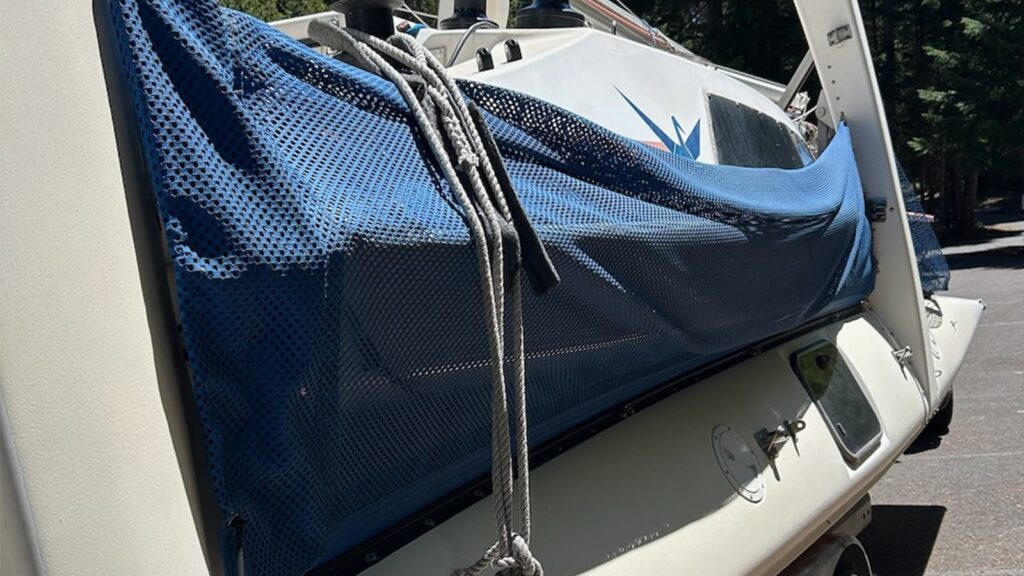
As trailers become more sophisticated, so do the responsibilities accompanying them. Dual axles, braking systems, and heavier loads increase capability, but they also demand greater attention to inspection, maintenance, and planning. A few practices have proven especially valuable for us:
- Trailer brake maintenance: Inspect brake actuators regularly to ensure smooth operation and freedom from corrosion. After immersion (particularly in saltwater), flush brake components thoroughly and monitor brake fluid levels and overall condition.
- Brake controllers (electric-over-hydraulic or electric systems): Verify proper calibration and function before longer trips. A simple test in a quiet parking lot can uncover issues before they become problems on the road.
- Axles and suspension: Dual-axle trailers distribute load more evenly and improve stability, but they also double the number of bearings, brakes, and tires requiring routine inspection and maintenance.
- Spare parts and tools: Carrying spare hub assemblies, extra brake fluid, and basic tools provides inexpensive insurance — especially when traveling to remote launch sites.
- Deeper route planning: As trips get longer and rigs get larger, planning extends beyond highways. We now pay close attention to fuel stops near primary travel routes and often review satellite imagery in advance. Can you visualize pulling in and out with a trailer in tow? Will congestion or tight access create a stressful stop? The discipline feels familiar; it’s the same mindset we use when planning routes on the water.
The complexity increases, but so does capability. With proper care and thoughtful preparation, larger trailerable boats remain remarkably mobile, opening the door to longer trips, more varied waters, and greater confidence, both on and off the road.
Myth #3: “Boat Ramps Are Stressful and Chaotic”
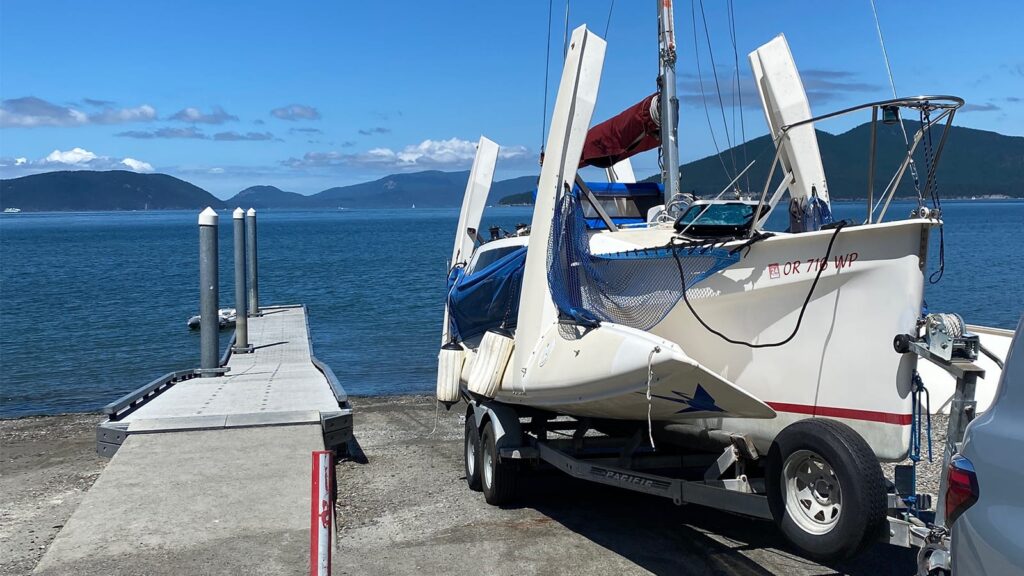
For many sailors, the boat ramp feels intimidating: busy, unpredictable, and high-pressure. Our early launches took place at mountain lakes accessed by national forest roads, often with simple ramps and limited facilities. Those experiences taught us ramps don’t have to be stressful, but they do reward the same preparation and situational awareness we rely on when entering unfamiliar anchorages.
Researching ramp conditions ahead of time makes an enormous difference. Understanding ramp quality, slope, dock availability, rigging space, parking logistics, and access fees helps remove uncertainty before you arrive. When available, a ramp with a finger dock is especially valuable, allowing the boat to be secured while the vehicle and trailer are moved, reducing both pressure and congestion.
Equally important, especially early on, is not trying to do everything alone. A second set of hands can spot while backing, manage lines during launch, or simply provide another set of eyes when things don’t line up perfectly.
Ramp etiquette is simply seamanship applied on land. Arrive prepared, keep your time on the ramp efficient, and be mindful of others waiting their turn. Before backing down, ensure dock lines are attached, fenders are deployed, gear and documentation are aboard, and PFDs are accounted for. The ramp is not the place to search for forgotten items.
Backing a trailer, like docking a boat, is a skill improving with practice. Time spent in an empty parking lot using cones or markers pays dividends later. When alignment goes wrong — and it will — the best move is often to stop, reset, and try again. Patience prevents mistakes, both on the water and on the ramp.
With preparation, practice, and a seamanship mindset, the ramp becomes less a source of stress and more a natural extension of the sailing experience.
What Trailer Sailing Gave Us Back
Trailer sailing didn’t just preserve our sailing life; it expanded it. Lakes, reservoirs, distant coastal waters, and spontaneous trips all became part of the picture. Sailing transformed from a fixed routine into a portable adventure.
For landlocked sailors, this flexibility is powerful. It means sailing on your schedule, choosing your water, and integrating sailing into life rather than organizing life around a single harbor.
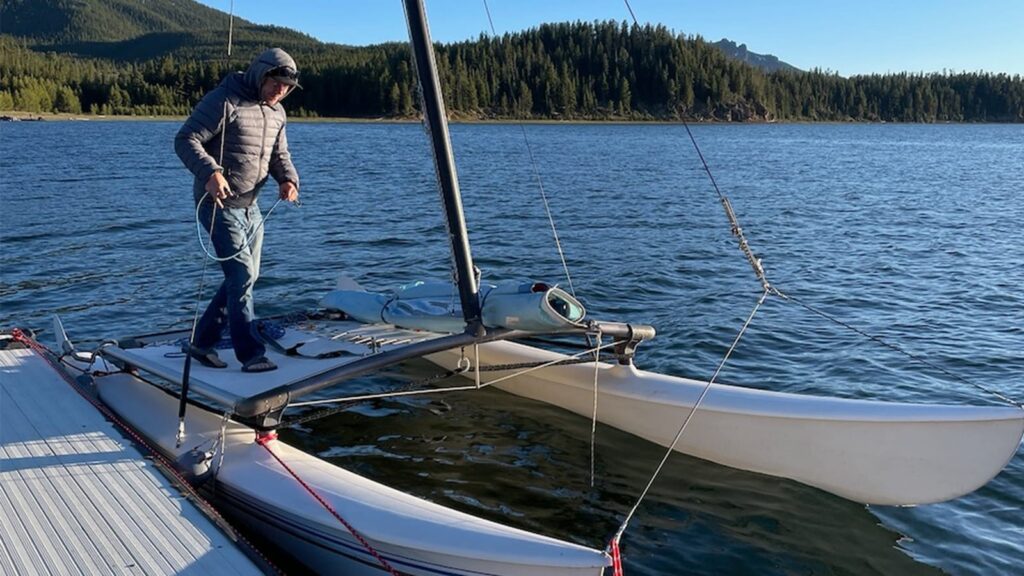
If you’ve moved inland and wondered whether sailing still belongs in your life, trailer sailing offers a compelling answer. It doesn’t require perfection or mastery on day one, only a willingness to learn, prepare, and adapt.
From simple single-axle trailers to complex dual-axle systems with brakes, the skills build naturally. The risks are manageable and the reward is well worth the effort.
Fair winds and happy miles!
Capt. Jon Lacks
Trailer sailor living in Central Oregon
USCG Licensed Captain and ASA Instructor
About the Author
Jon Lacks is a USCG OUPV Captain and ASA 201/203 Sailing Instructor with lifelong experience on the water. He grew up sailing and later teaching in Massachusetts and Rhode Island as a U.S. Sailing Small Boat Instructor before competing as a collegiate sailor and racing J/24, J/30, and J/105 programs throughout New England. After moving to the Pacific Northwest seven years ago, Jon earned his ASA Instructor certification at Modern Sailing in San Francisco Bay. Today, he’s a dedicated trailer sailor based in Central Oregon, exploring mountain lakes and the Puget Sound with his family aboard a Corsair F-27 trimaran.
Join The Discussion
-
What are your thoughts on trailer sailing?
Do you have experience with trailer sailing? What do you think are the pros/cons?
Read more about trailer sailing, including myth busting and lessons learned by a landlocked captain: https://americansailing.com/articles/encouraging-landlocked-sailors-to-embrace-traillor-sailing
americansailing.com
Encouraging Landlocked Sailors to Embrace Trailer Sailing
Trailer sailing makes sailing portable and helps inland sailors access new waters with confidence, flexibility, and freedom.
Sorry, there were no replies found.
Log in to reply.