
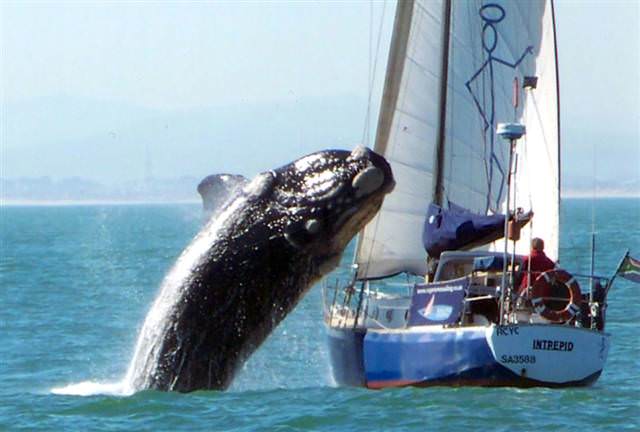

I assume by now you’ve all seen this:

But it’s so completely insane I had to repost the picture. (And have you seen the video of it?? I can’t decide if it’s fake or real or what…)
Whale run-ins are the only thing I can think of that a sailor can’t do anything to prepare for. Poor visibility, no problem. Light winds, fine. Even storms are manageable, with the right sails, ground tackle, self-steering, drogues. Shoot–we have tactics for lightning strikes. But hitting a whale? (Or in this case, a whale hitting you??) Completely unpredictable, and not a dang thing you can do about it.
For how many yachts sink from hitting whales at night (snapping off the keel, thudding a whole in the hull), it’s amazing that the whale jumping on top of this boat didn’t sink it.
Being a cruiser myself, I’ve had many a night watch on the Pacific Coast to fret about hitting a migrating whale. On the most extravagant end of my wish list is one of those new FLIR thermal imagers that can detect things underwater like radar…but they start at around $5,000. Instead, I learned a thing or two about whales to help minimize the chances of hitting one.
1. When you spot a whale, it’s easy to let the wheel drift towards it. But make sure you stay at least 300 feet away from them, because the closer you get, the more curious they become about you.
2. Whales have poor eyesight and trouble hearing sailboats, so it’s a good idea to turn on the engine when you know whales are nearby. If they can hear you, they’re less likely to surface blindly underneath you–or jump on top of your boat.
3. Whale watching guides recommend keeping yourself behind the whale and always maintaining a constant speed. Rapid changes in direction or speed may trigger defensive action from the whale, (although jumping on top of your boat is not normally one of these!).
4. Keep in mind that the governments of Canada, Mexico, and the US have passed laws regarding whale watching practices for private boaters. Here is a link to NOAA’s guidelines and regulations.
It’s important for sailors’ safety as well as for consideration of the whales that you follow these safe whale watching guidelines. At night, a healthy dose of telepathy–“stay away from our keel, whales”–is the most effective method I’ve found. So far, it’s working for me.